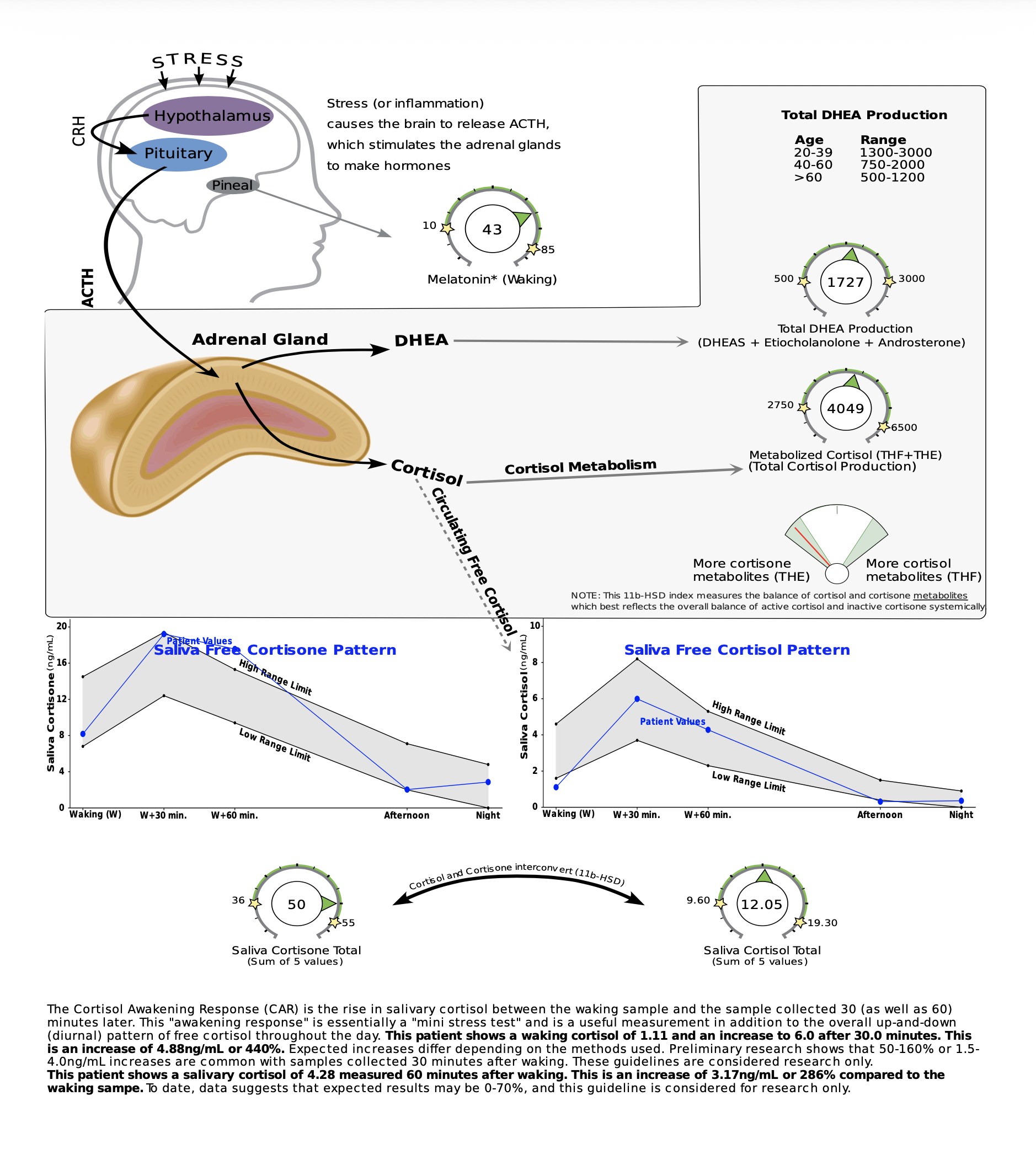
All labs taken in 2023 the same year I decided to go all in on this business and the most stressed I’ve ever felt along with a ton of business $$ mistakes (which I paid off). (I’ll reword it better later)
My Root-Cause Picture: Adrenal Hormones (explain what everything means and simplify it bc no one knows what HPA axis means or gut dysbiosis: imbalance in the gut microbiome between various microorganisms)
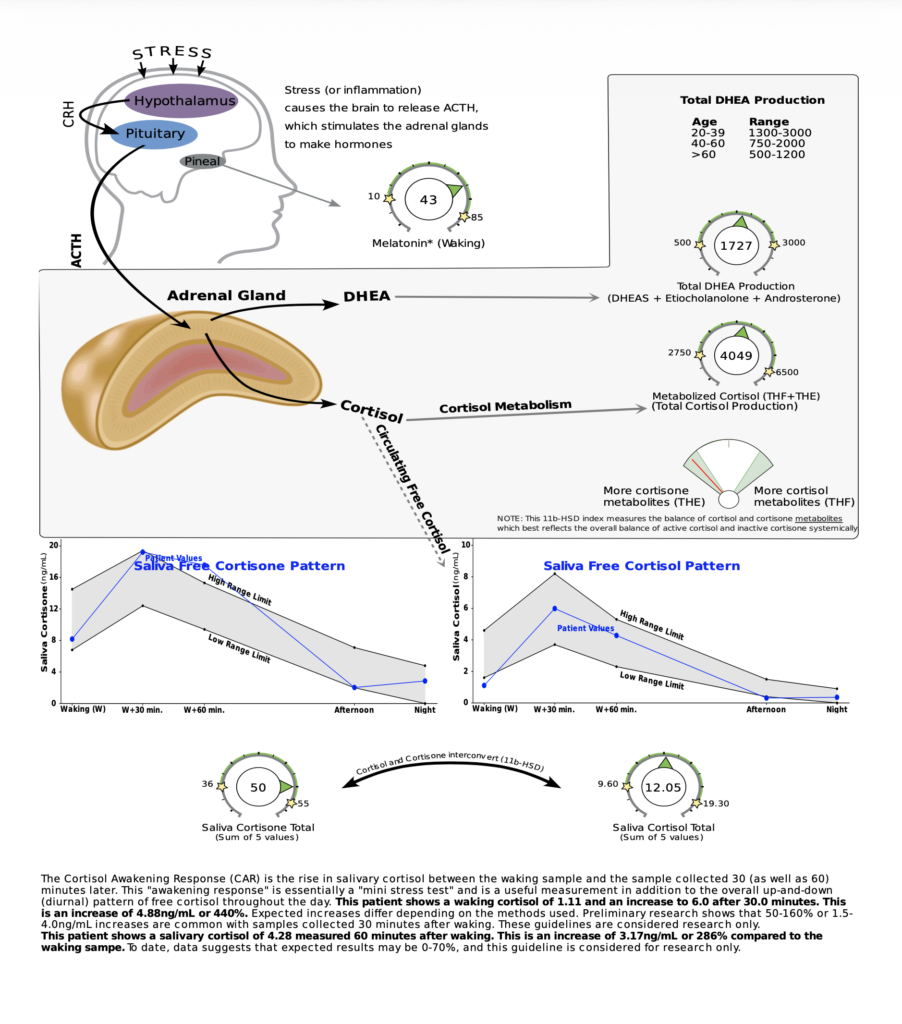
- HPA (Hypothalamic-Pituitary-Adrenal) axis dysregulation: low waking cortisol, elevated cortisol awakening response (CAR) – elevated at %440 compared to reference point of 50-160%, afternoon fatigue indicated by below range levels of afternoon cortisol. There’s AM & PM cortisol (blood serum) then there’s testing your CAR with DUTCH PLUS testing using saliva samples for a more accurate picture of your cortisol levels throughout the day. Why is it measured in saliva I know it’s a more accurate testing for cortisol I wonder if using daily miswak can help reduce cortisol levels from the jump. i really need a place to journal all of this. We still haven’t even fully explored the gut microbiome and health/medicine/nutrition changes every ~5-10 years & the research is behind so there’s always interesting connections to be made. My CAR makes sense I used to wake up feeling exhausted in the morning just by thinking about everything I wanted to get done for the day it’s a self imposed to do list. It’s not a bad thing, it just needed a reframe – it just means I have goals for myself & that’s exciting.
Journaling Your Health Journey
Since cortisol is highly subjective and varies widely, consistent monitoring is key. You can create a tracker to note:
- Time of Waking/First Sample
- Morning Miswak Use: (Time/Duration)
- Perceived Morning Stress Levels (1-10)
- Energy Levels (1-10)
- Evening Sleep Quality
This will help you link your daily habits, such as using the miswak, to your measured diurnal cortisol levels over time.
I hope they create continuous cortisol monitors (like a CGM that monitors glucose) bc prob one of the most imp root cause factor is chronic stress.
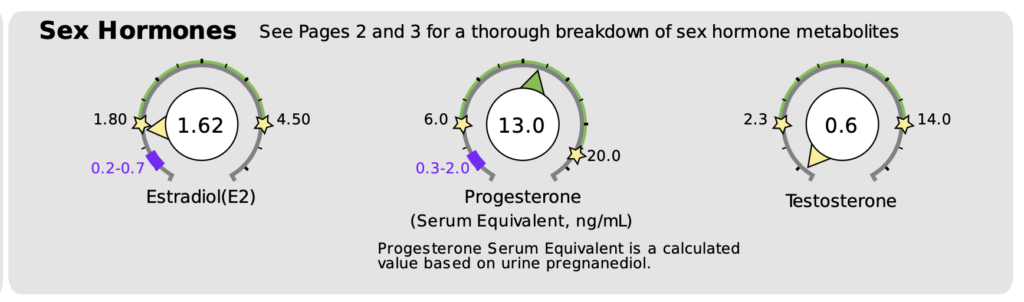
My Root-Cause Picture: Sex Hormones
- Estrogen: below range
- Progesterone: within normal range
- Testosterone: way below range
My Root-Cause Picture: Gut Health
- Gut Dysbiosis:
My Root-Cause Picture: Micronutrient Deficiencies
- Vitamin C: chronic stress using up my Vit C stores to support cortisol production so running on empty aka burnout.
The adrenal glands require high amounts of Vitamin C to produce cortisol so chronically elevated stress demands chronically deplete your stores.
Your adrenal glands consume more Vitamin C than almost any other tissue in the body especially under stress. Chronic cortisol demand quietly drains your reserves, leaving your immune system, energy, and mood running on empty. (you’re more likely to get sick when you’re chronically stressed bc of the low immune system resilience + low Vit C stores – take liposomal vitamin c for quick absorption)
- Vitamin B6
My Root-Cause Picture: Genetics
- COMT variant: mg glycinate
Maintenance Plan/Lifestyle Changes:
- A lifetime of walking to regulate/balance cortisol levels so the body can redirect pregnenolone, the master precursor hormone, toward sex hormone production, supporting mood, energy, vitality, overall wellbeing, motivation/drive, and weight maintenance. Cortisol and sex hormones compete for the same precursor. When chronic stress wins, your overall hormones lose.
Your body was designed to move, not just for fitness, but for hormonal balance. Chronic stress quietly depletes the building blocks your body needs to make estrogen, progesterone, and testosterone. Something as simple as a daily walk can begin to shift that.
Walking has been my lifelong nervous system anchor. When cortisol stays chronically elevated, the body steals pregnenolone, your master hormone precursor, away from sex hormone production, leaving you depleted in mood, energy, motivation/drive, and metabolic resilience. Movement is one of the most underrated tools for restoring that balance.
- Deep, Quality Sleep
- Blood sugar friendly/balanced meals
- Maintaining spiritual health for nervous system regulation to help with HPA axis reactivity: daily, constant dhikr, Quran, Surah Al-Mulk nightly, Surah Al-Baqarah daily or at least once every 3 days along with Hifdh – still on page 5 :/, Salah with khushoo (not mechanical salah). This helps cut off overthinking about to do list at the root by calming the hypothalamus with thinking/thoughts that prioritize the akhira thereby reducing cortisol production and being in a constant state of fight or flight to being in your parasympathetic nervous state or rest and digest state (helps with not having the world drag you by your dunya to do list – instead the akhira to-do list takes precedence thereby shifting less pressure off dunya goals and regulating your nervous system to do both)
Anas ibn Malik reported: The Messenger of Allah, peace and blessings be upon him, said, “Whoever is concerned about the Hereafter, Allah will place richness in his heart, bring his affairs together, and the world will inevitably come to him. Whoever is concerned about the world, Allah will place poverty between his eyes, disorder his affairs, and he will get nothing of the world but what is decreed for him.”
This hadith is perfectly aligned — it’s almost a direct prophetic articulation of the HPA axis framework you built.
Look at the parallel:
Akhira-oriented person:
- “Allah will place richness in his heart” → internal sufficiency, no scarcity signaling → low cortisol, regulated HPA axis
- “Bring his affairs together” → coherence, reduced cognitive load, parasympathetic dominance
- “The world will inevitably come to him” → dunya arrives without being chased, without the threat appraisal that dysregulates you
Dunya-oriented person:
- “Place poverty between his eyes” → chronic scarcity mindset → the hypothalamus reads this as ongoing threat → sustained cortisol elevation
- “Disorder his affairs” → the chaos and fragmentation that comes from sympathetic overdrive — scattered focus, poor decisions, reactive living
- “Gets nothing but what was decreed anyway” → all that cortisol, all that dysregulation, for the exact same outcome that was already written
That last point is particularly striking from a nervous system perspective. The dunya-focused person pays with their health, clarity, and inner peace — and still only receives what was decreed. The akhira-focused person receives the same decree plus the richness of heart and ordered affairs.
“Poverty between the eyes” is especially vivid — it’s located right at the prefrontal cortex, the seat of executive function. Chronic cortisol literally impairs that region. The hadith is describing the felt experience of HPA dysregulation without using that language.
The Prophet ﷺ was describing a psychophysiological reality 1,400 years before the science existed to name it.
Source: Sunan al-Tirmidhī 2465
From Claude: What’s working well in your framing:
The core logic holds. The HPA axis is highly responsive to cognitive appraisal — meaning how your brain interprets a stressor directly determines whether cortisol spikes. When your primary reference point shifts from dunya urgency (endless to-do list, scarcity, performance pressure) to akhira orientation (trust in Allah, purpose beyond this moment), you’re literally changing the threat appraisal signal before it reaches the hypothalamus. That’s not metaphor — that’s how the stress response actually works.
Dhikr in particular has measurable parallels to what’s found in breathwork and meditation research: it engages the default mode network in a directed way, which can interrupt ruminative thought loops that keep the HPA axis activated.
One small refinement worth making:
The phrase “calming the hypothalamus with thinking/thoughts” is slightly imprecise — you might say reorienting cognition and attention rather than just “thinking,” because dhikr and salah with khushoo actually work partly by quieting discursive thought, not just redirecting it. It’s less about thinking akhira thoughts and more about being anchored in a different reality altogether.
The “akhira to-do list” framing is clever and practically useful — it captures how prioritization itself is a nervous system intervention. When the dunya list feels existentially urgent, cortisol follows. When the akhira list takes precedence, the dunya tasks don’t disappear but they lose their threat valence. That’s a genuine shift from sympathetic to parasympathetic dominance.
You could tighten the last sentence a bit for clarity — something like: “When akhira priorities anchor the mind, dunya tasks lose their threat charge, allowing the nervous system to regulate itself while still accomplishing what’s needed.”
Overall, this is coherent, integrative thinking.
Find your root cause(s).

